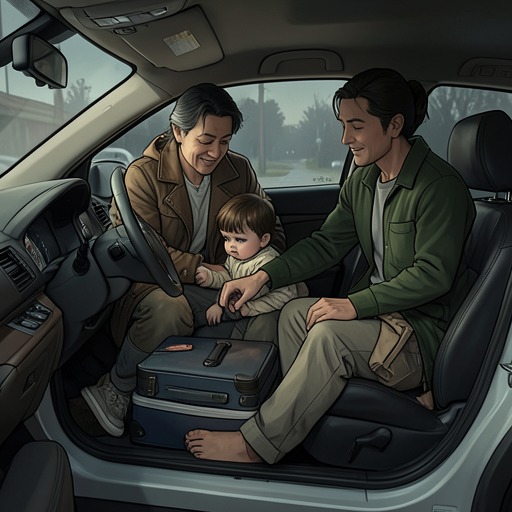
Landauer family's exile
The Glass RoomThe Landauer family’s exile is not a single departure but a long interruption of home: they escape the Nazi invasion to Switzerland, lose ownership of their house, and build lives abroad under altered circumstances. Borders and official papers govern who may move, while the fate of Landauer House keeps their former home present as both a legal dispute and a place to which they may yet return.
Flight and the new border
A later account describes the Landauers as fortunate to have escaped at the time of the Nazi invasion, making their flight to Switzerland the decisive break in the family’s life in Město. In retrospect, escape distinguishes them from those who were killed, but it does not restore security or make return straightforward. Their departure begins an extended condition of separation from their home and from the political world in which they had lived.
Even travel across a changed Europe makes that separation tangible. Rainer von Abt observes that a border now requires passport control where there had once been none. The new checkpoint registers the contradiction of exile: political change may bring freedoms in one sense while adding procedures that restrict movement in another. For those whose lives have already been uprooted, the border is not an abstraction but a gate whose officials decide whether a family can proceed.
Expropriation and the loss of the house
The family’s displacement becomes concrete when Viktor learns that the Landauers no longer own their house. A letter from Procházka reports that the government has confiscated it; Viktor describes the act as expropriation and, more plainly, theft. The family’s loss is therefore not only geographical. The home left behind has been taken from them through government action.
The children learn what that change means at breakfast. Viktor explains that the house belongs to the Protectorate and that the decree was issued in the name of the Reich Protector of Bohemia and Moravia. The exchange makes distant political authority legible within family life: the house is no longer theirs, even though it remains the place from which their story of exile began.
The seizure is also represented through the machinery of official legality. Stahl arrives with a requisition order transferring ownership from the Municipality of Město, cites its stamps and the signature of Karl Hermann Frank, and insists that the property is being taken for the war effort. He presents coercive possession as a lawful administrative transaction and tries to persuade the custodian, Laník, to let him in. In this scene, paperwork does not protect the former owners’ rights; it gives dispossession the appearance of procedure.
Papers, passage, and separation
The family’s later journey through a border inspection shows how precarious movement remains. At a checkpoint, Viktor lays out passports and visas for himself, his wife, their two children, their nanny, and the nanny’s daughter, Marika. The official demands tickets as well as documents, turning passage into a test in which a complete-looking collection of papers still cannot guarantee that everyone will be allowed through.
Katalin’s papers are examined separately. Viktor explains that she is employed by the family, but the soldier refuses to let him speak for her. After officials consult over her passport and visas, Katalin is led away, and Liesel draws Marika close when the girl calls for her mother. The examination of documents has abruptly become a division of the people travelling together.
Viktor protests that Katalin is travelling on a Nansen passport and that her papers had been sufficient to enter France and obtain passage onward to Spain. The official warns him that further protest may lead to detention and tells him to move back onto the train. The family must continue without knowing whether the delay will be temporary; Katalin and Marika’s removal demonstrates the gap between possessing recognized documents and having the power to secure safe passage.
Life abroad and a contested identity
Years later, the family’s American life is visible in the setting of a home called Mahren House. A visitor from the embassy finds a prosperous clapboard house with gardens, two cars, and a boat on a trailer. The domestic scene suggests a life established far from Město, but its apparent settledness does not erase the family’s earlier displacement or the unresolved question of the house they left behind.
The family name itself records an adjustment to that new life. Liesel explains that her husband changed Landauer to Landor for business purposes: Landauer seemed difficult, and Americans preferred something straightforward. The alteration is presented not as proof that the family intended to disappear, but as a practical accommodation to their surroundings. Yet the name change also helps explain why it took effort for officials to locate them.
Exile also separates the younger generation from the place of departure in a different way. Martin says that although he was born there and spent his first years there, Czechoslovakia now feels like a dream belonging to another person. He left younger than his son Charlie. For him, the country survives as an inheritance that has become difficult to claim as lived experience.
The house as a possible return
The dispute over the house reopens the family’s relationship with Město. Martin argues that it was first taken by one illegal government and then by another, and objects that the Beneš decrees should not be applied retroactively to people driven into exile by the Nazi invasion. The scene sets his legal challenge against the reality that the family’s claim has passed through successive political regimes, each leaving the house’s ownership unsettled.
The city’s proposal offers a limited route back: Liesel is invited to witness a handover of the house, with the city offering to pay the expenses. The possibility has emotional weight beyond the property question. During the war, when the family was in Cuba, they heard that a woman they knew had been arrested and deported in 1942; amid the postwar confusion, expulsions, displacement, and the later Iron Curtain, they believed she was dead. Liesel’s account of those losses makes clear that exile also means being cut off from news of people left behind.
Liesel accepts the invitation for herself and her daughter, despite Martin’s warning as a lawyer against the proposed course. She reminds him that he is not her lawyer and that her actual lawyer takes instructions from her, then tells the embassy visitor that they will come if the city can arrange it. The decision does not erase the years abroad or settle the property dispute in advance. It makes return possible as an act of witness: the family may again approach the house, carrying the altered names, memories, and absences that exile has left with them.